
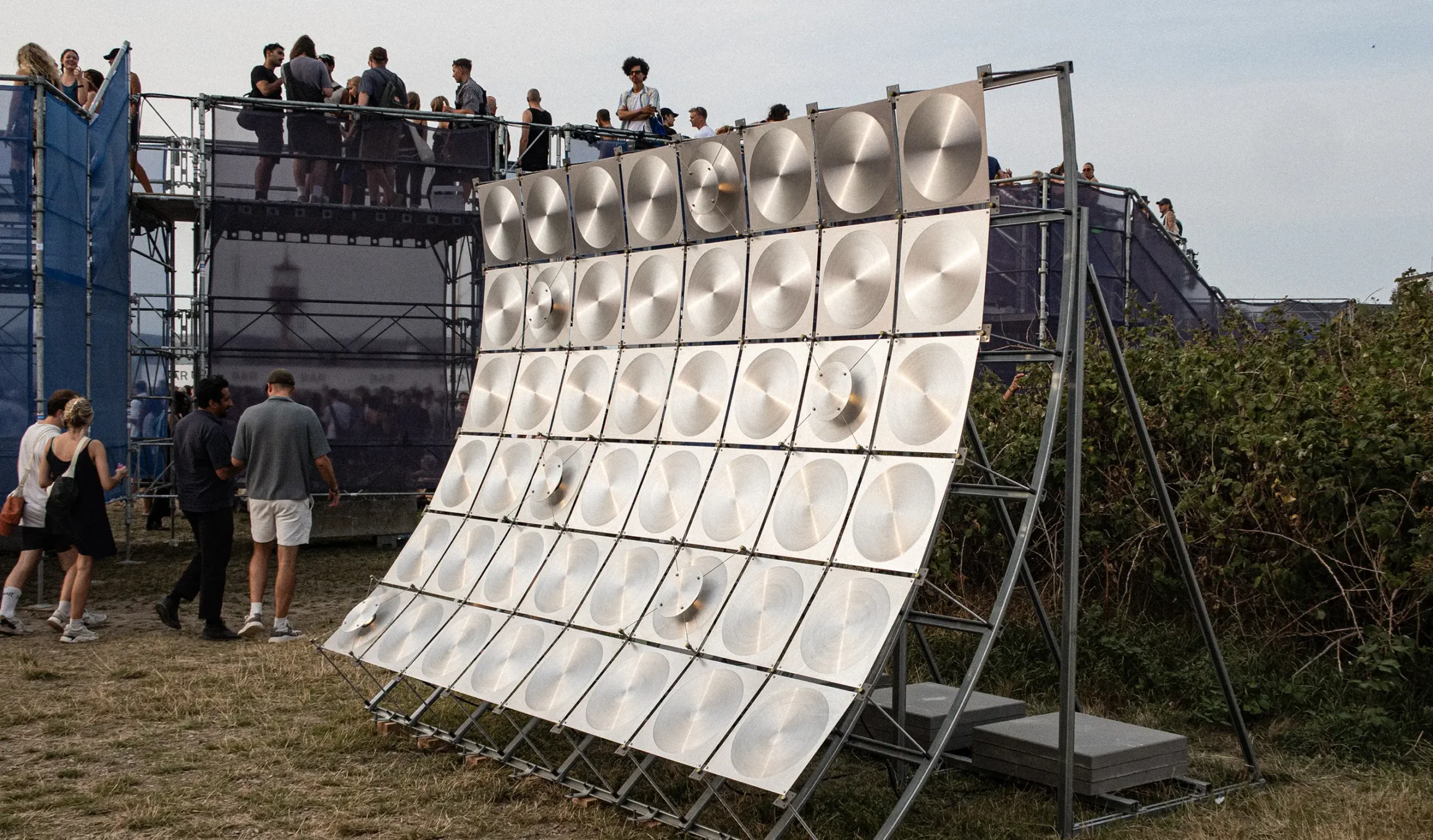
At O Days Festival 2026 in Copenhagen, sound takes a strangely quiet form. Speaker, a new installation by Copenhagen-based studio Frederik Gustav, borrows the unmistakable geometry of a loudspeaker and removes everything that makes it function as one. No sound comes out of it. Instead, the piece catches light, bodies and fragments of the surrounding festival, turning a familiar piece of audio hardware into a large-scale visual surface.
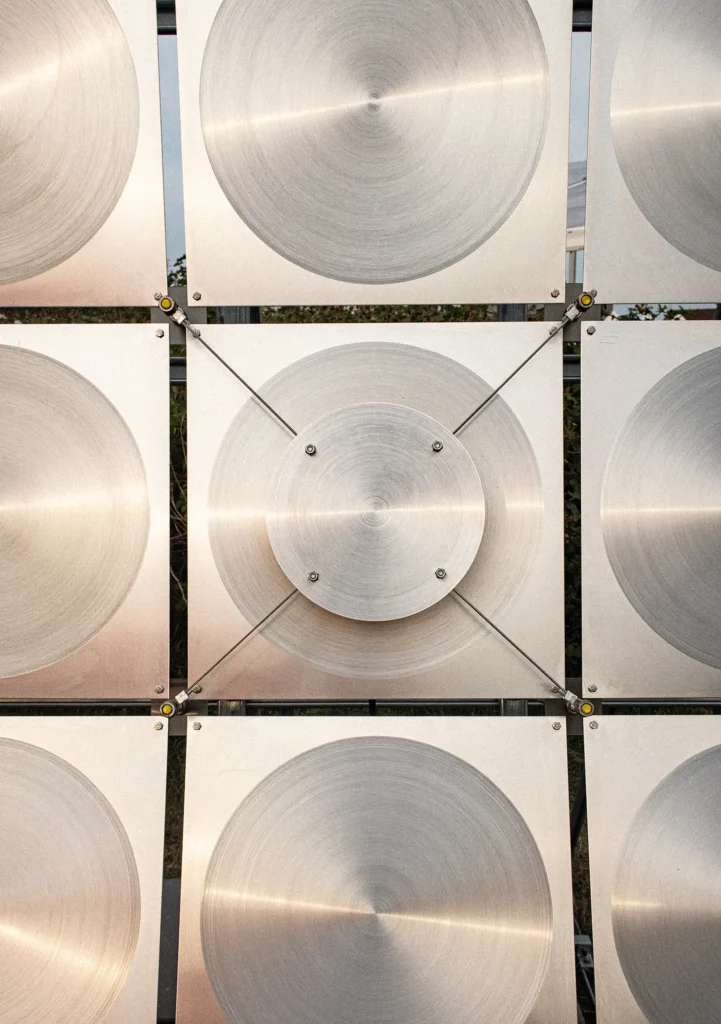
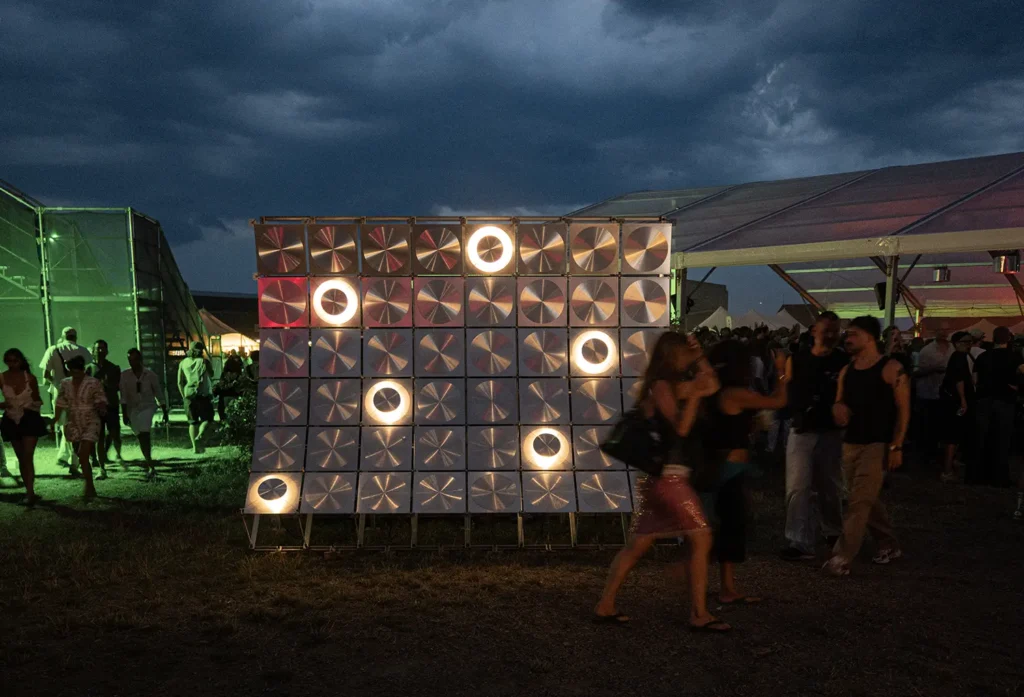
Installed on the waterfront of Refshaleøen, the work consists of a curved metal structure covered with dozens of circular brushed-aluminium panels. Each panel carries the concentric relief associated with a speaker cone, but here those rings have no acoustic purpose. Repeated across the entire structure, they form a dense field of circles that shifts depending on where the viewer stands.
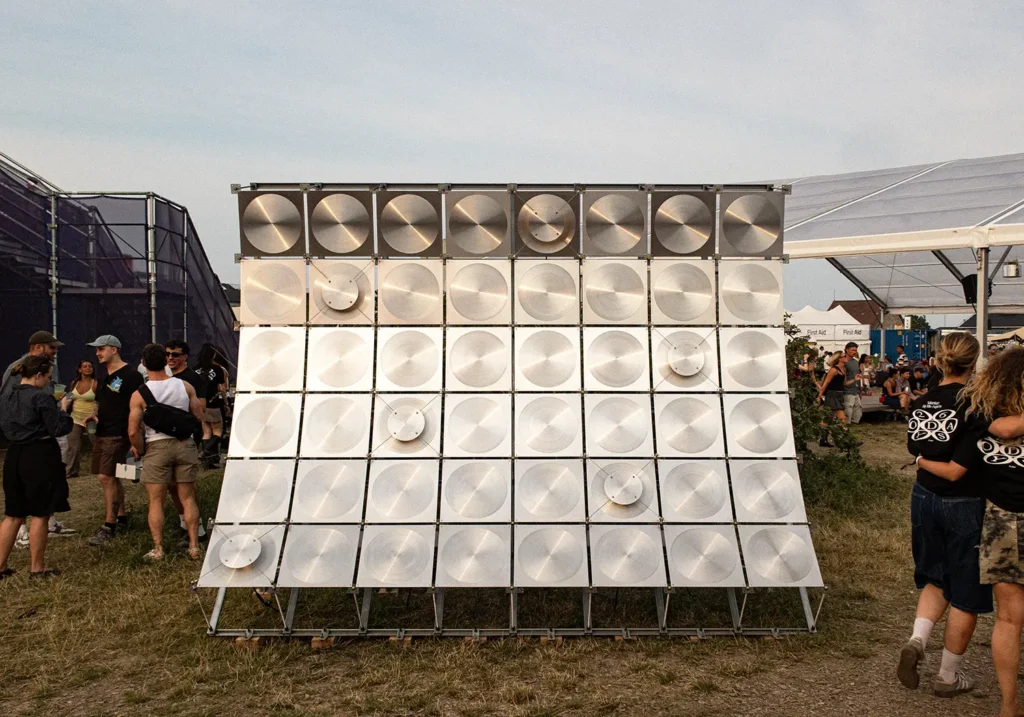
The effect is never fixed. In direct daylight, some discs appear almost white, while others fall into darker tones as the surrounding light changes. Walk a few steps and the arrangement alters again. Reflections break apart, surfaces disappear into shadow, and the installation seems to reorganise itself without a single mechanical element moving.
That instability is central to Speaker. The work does not rely on screens, projections or programmed effects. Its visual activity comes from aluminium, sunlight and the movement of people around it. The audience completes the piece simply by occupying different positions within its field of reflection.
The connection to sound remains present in the construction, but only as a point of departure. The circular forms reference speaker cones without attempting to reproduce an actual loudspeaker. Frederik Gustav extracts the shape from its original context and gives it another function, allowing acoustics to become surface, rhythm and light.
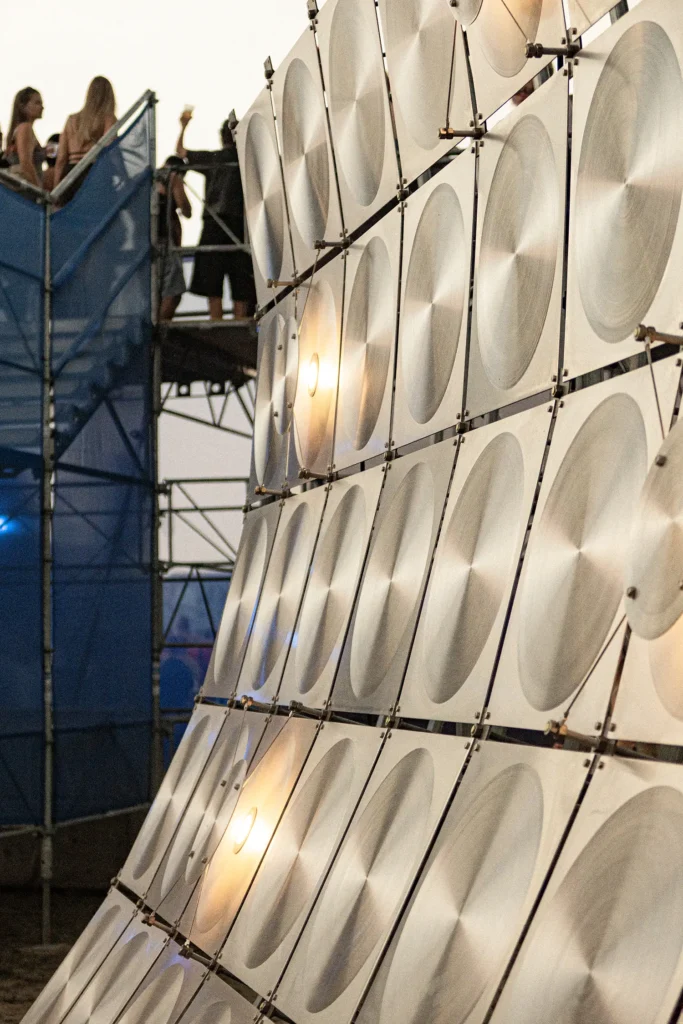
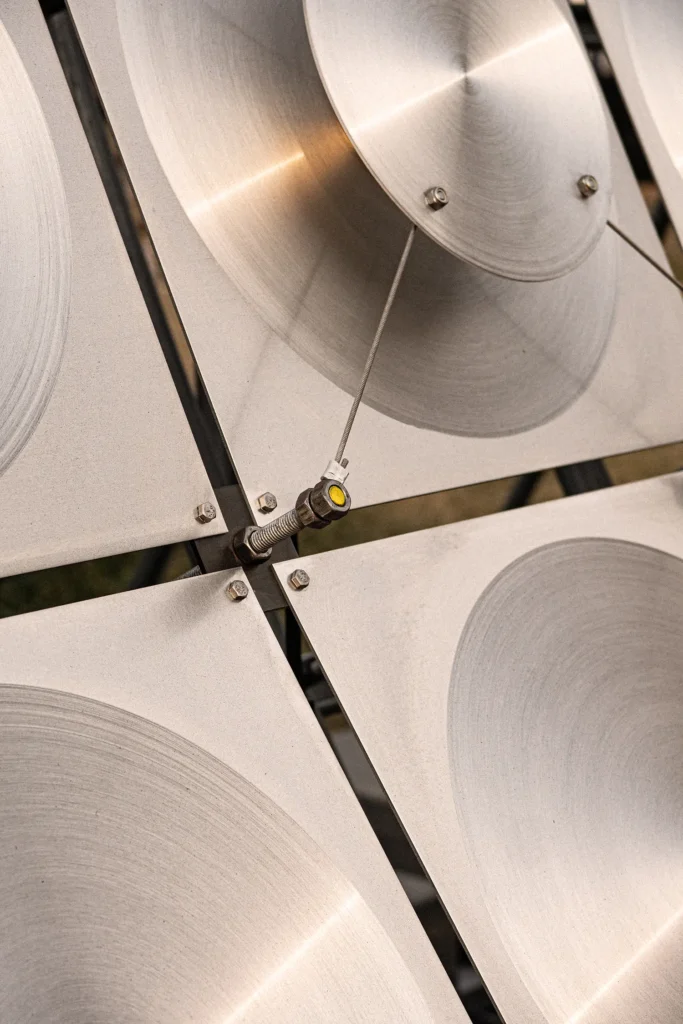
The structure is deliberately exposed. Bolts, cables, turnbuckles and joints remain visible between the aluminium discs, making the mechanics of the installation part of its appearance. Nothing has been polished into invisibility. The construction is allowed to remain legible, giving the work a physical directness that runs through the studio’s wider approach to objects, interiors and installations.
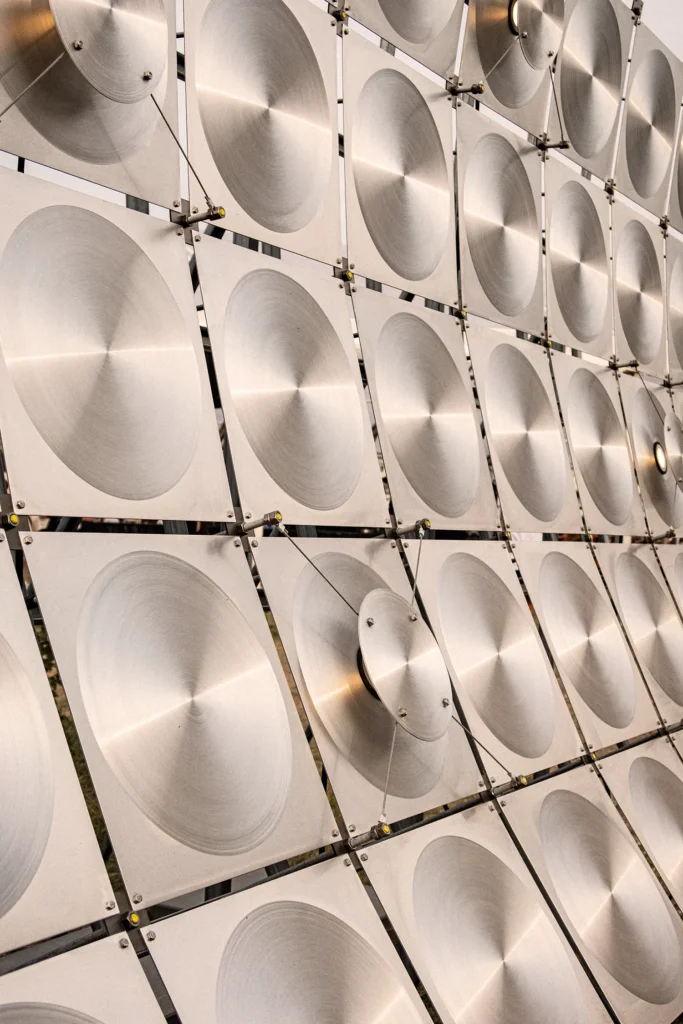
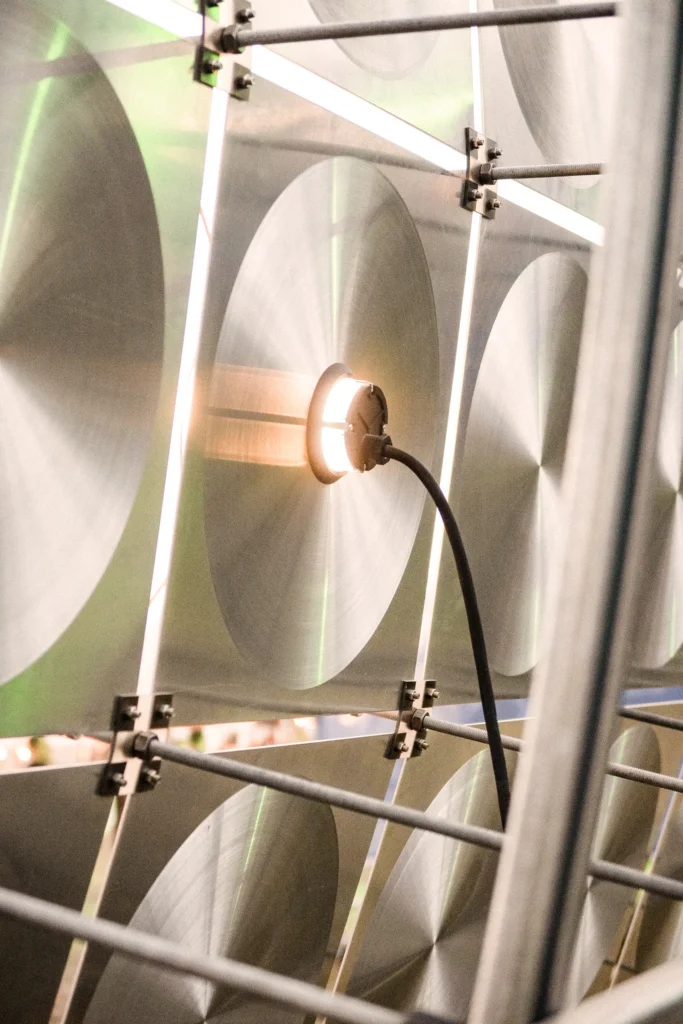
After dark, Speaker acquires another identity. Small sources of warm light positioned behind selected discs begin to glow through the circular surfaces, creating isolated points across the otherwise subdued aluminium. The illuminated panels appear at irregular intervals, while the rest of the structure absorbs the changing colours of the festival around it.
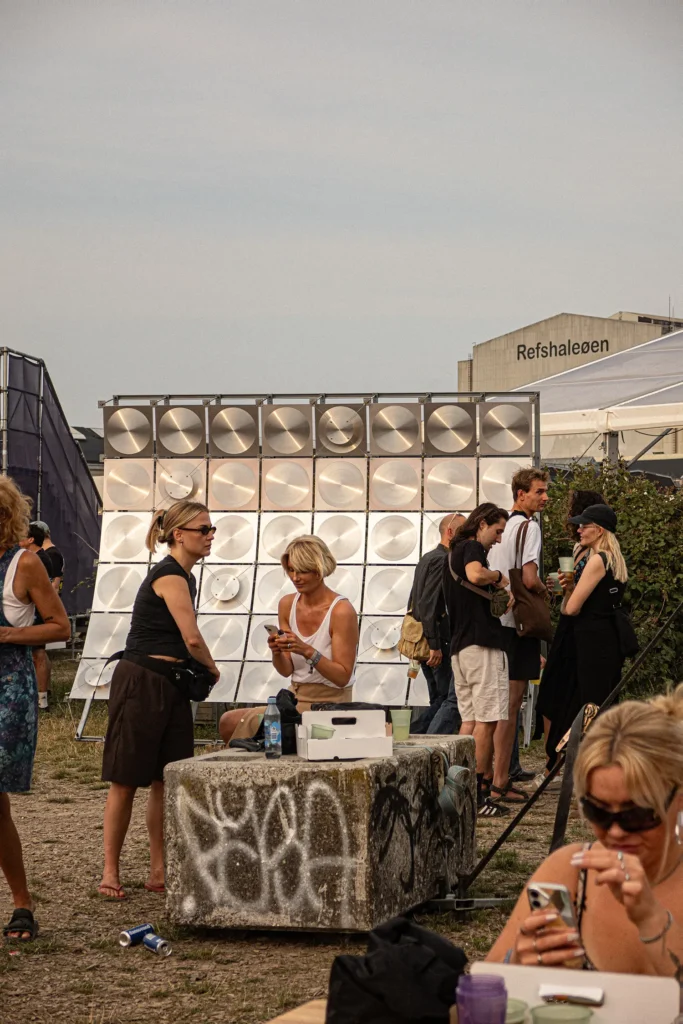
Its position at Refshaleøen makes the audience impossible to separate from the work. People passing between stages, standing nearby or stopping for a moment are caught across its reflective surface. Faces, silhouettes, lights and fragments of the waterfront enter the composition briefly before moving away. The installation therefore never presents exactly the same image twice.
This relationship between structure and movement also reflects the practice of Frederik Weber and Gustav Dupont, who studied together at The Royal Danish Academy of Fine Arts before establishing their workshop in Copenhagen. Their work moves across objects, interiors and larger installations, often leaving materials and methods visible rather than treating them as elements to be concealed.
With Speaker, that approach becomes particularly effective because the object is built around a contradiction: something designed according to the anatomy of sound that ultimately produces none. What remains is the physical language of the loudspeaker, its circles, depth, repetition and proportions, redirected entirely towards light and perception.
And perhaps that is what makes the installation work so well within a festival environment. It does not compete with the music surrounding it. It simply watches everything happen, reflecting fragments of the crowd, the architecture, the sky and the lights back into the night.
Follow Frederik Gustav on: Website / Instagram
Photo by (c) Frederik Gustav
