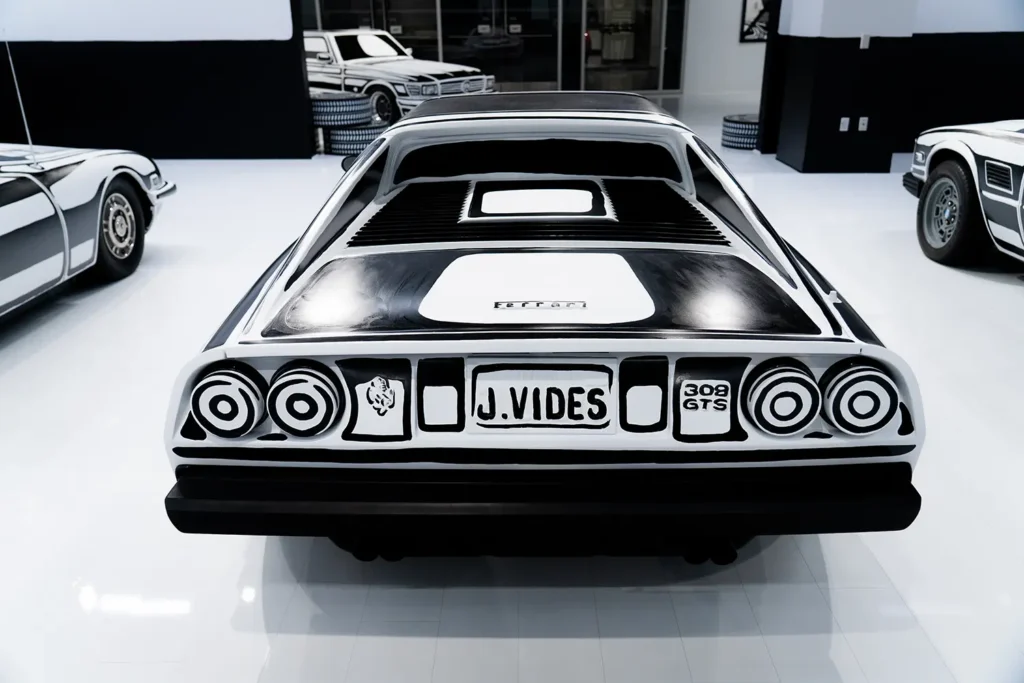
For nine days, Joshua Vides worked inside the Petersen Automotive Museum with a deceptively simple premise: take five real cars, take away their visual depth, and redraw the entire room around them.
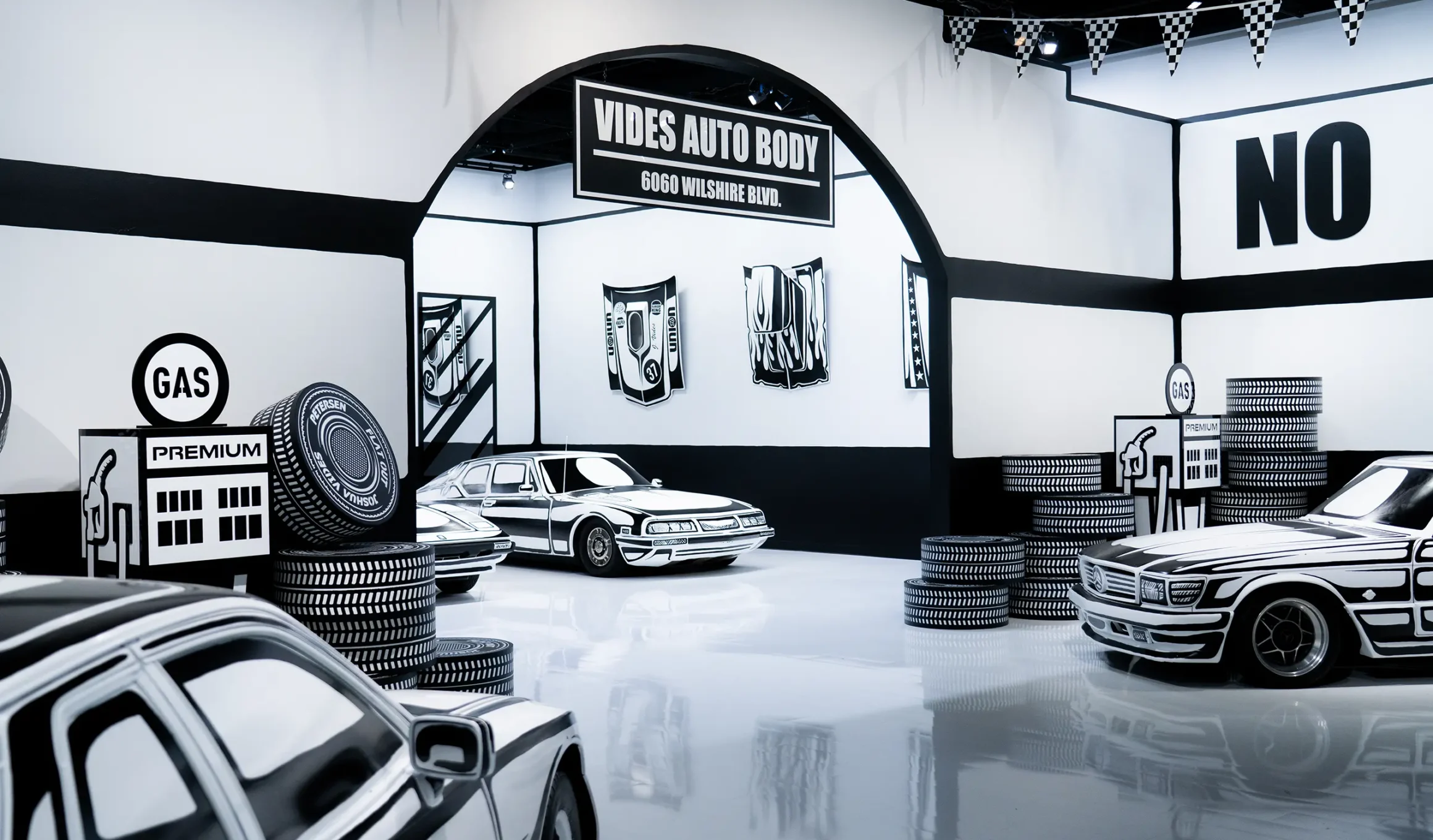
The result is Flat Out: The Art of Joshua Vides, an installation that occupies the Armand Hammer Foundation Gallery as a monochrome environment where vehicles, walls, tools and architectural details have been pulled into the same graphic language. What would normally function as the setting for an exhibition becomes part of the artwork itself.
Vides is known for his Reality to Idea approach, a practice built around reducing three-dimensional objects to sharp black contours against white surfaces. Over the years, the method has travelled across sneakers, guitars, mirrors and automobiles, appearing through collaborations with brands including Nike, Converse, Fendi, Google and G-Shock. Here, however, the scale changes the proposition.
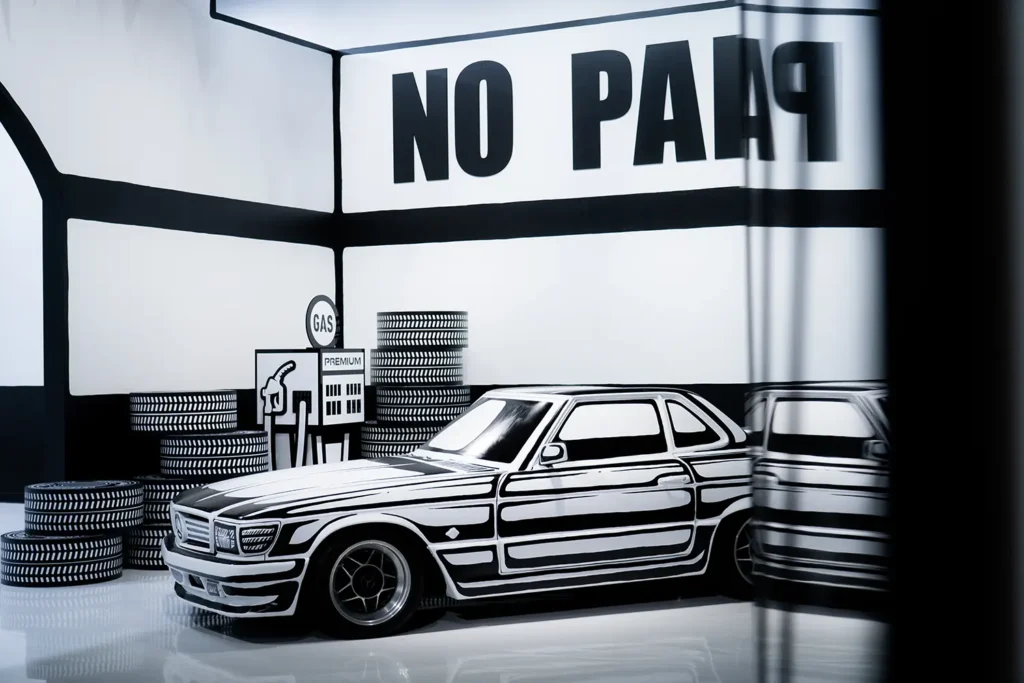
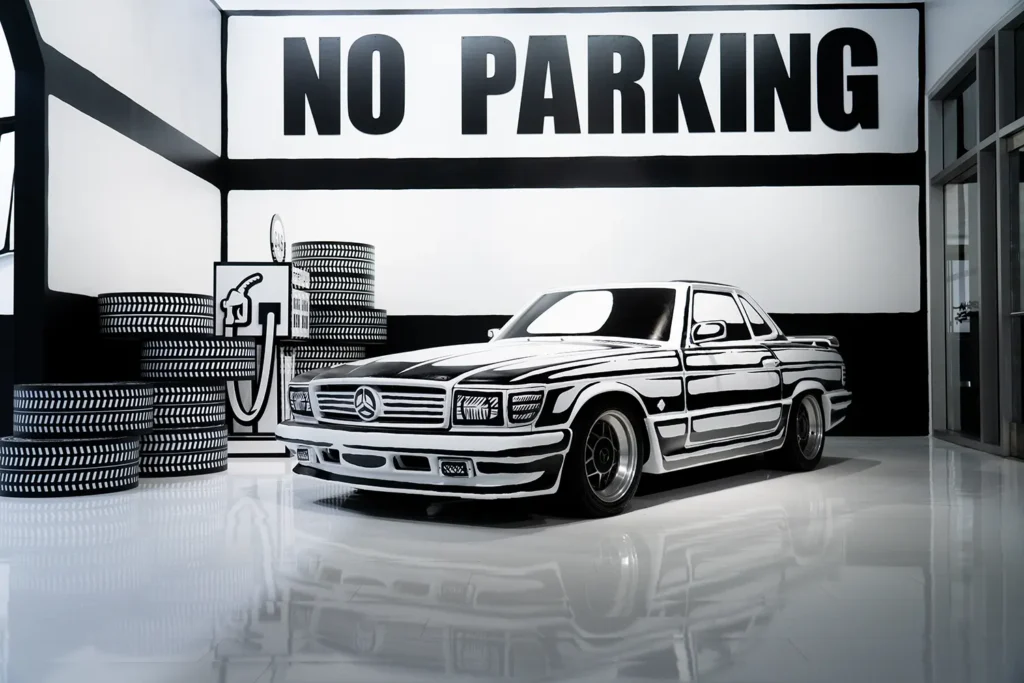
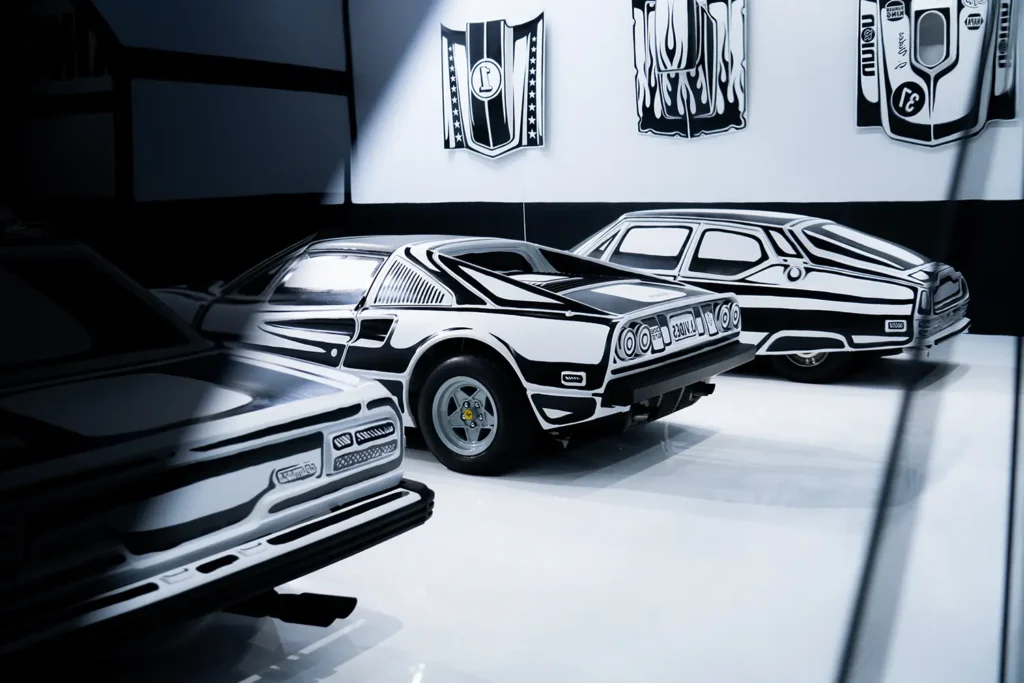
Five different vehicles sit at the centre of the gallery, each treated individually rather than processed through a fixed template. Their proportions, panels and surfaces determine where the lines go. The cars remain recognisable, but their visual information has been reduced to the marks necessary to describe them.
That distinction becomes especially important once the treatment leaves the vehicles behind.
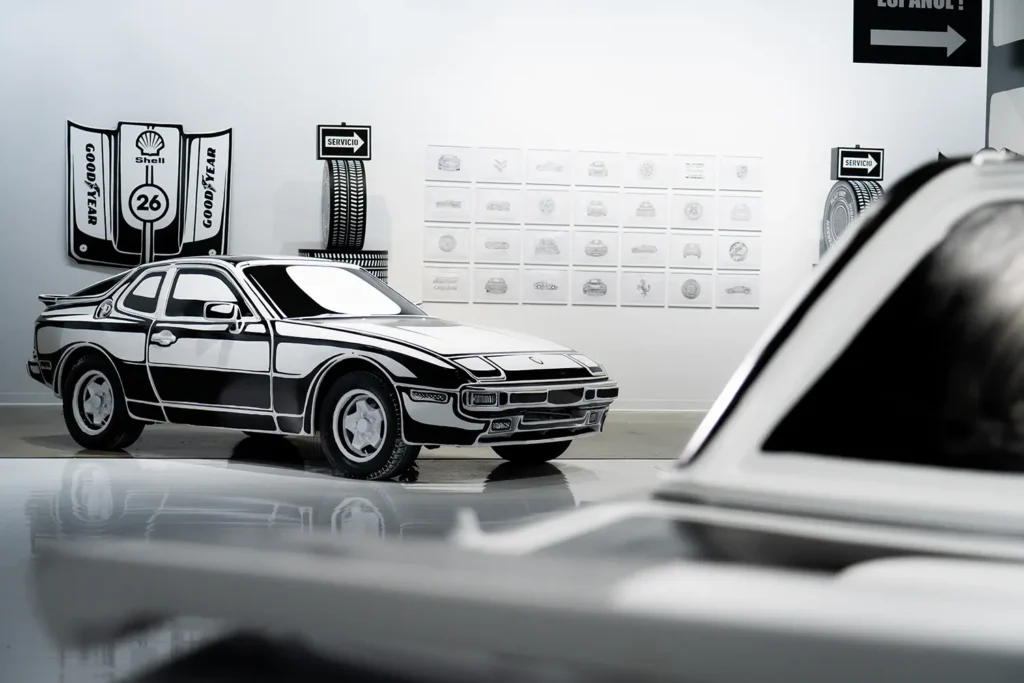
Vides has painted the surrounding gallery in the same stark vocabulary, extending the black outlines across walls and objects until the distinction between exhibition, architecture and illustration becomes increasingly difficult to locate. Tools become graphic symbols. Structural elements become drawn contours. The room itself appears to have been edited into the same visual register as the cars occupying it.
Nothing is left to colour, texture or conventional automotive detailing. The installation depends almost entirely on line, proportion and placement, which makes precision essential. Across nine days of hand-painting, Vides transformed the gallery and its five vehicles one surface at a time, with every mark becoming part of the final composition.
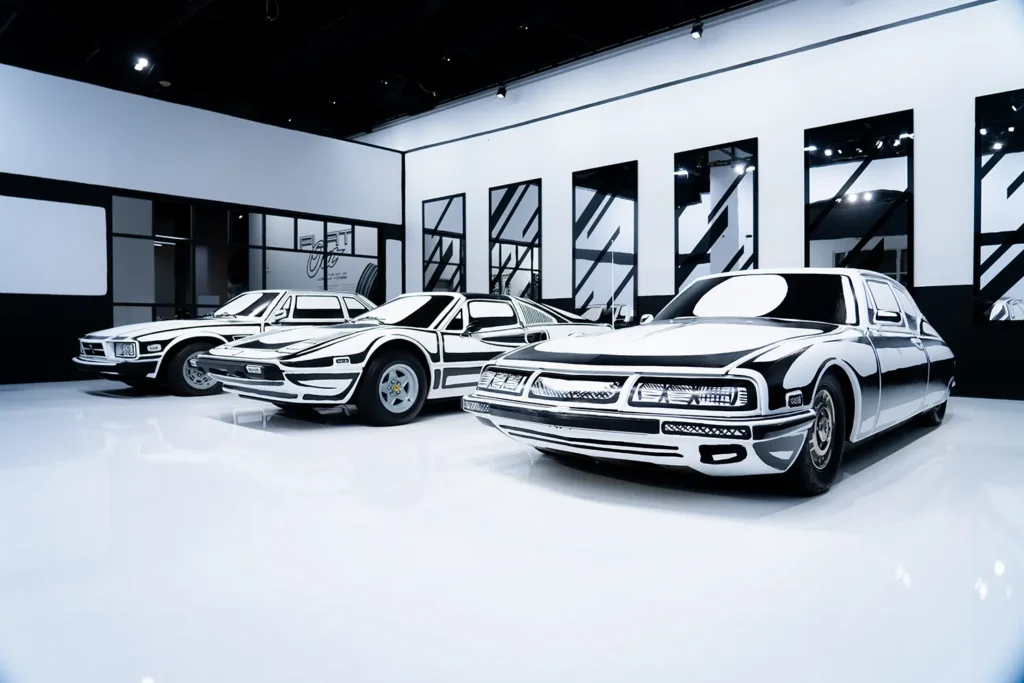
The decision to work directly onto full-size cars also gives the project a particular physical tension. These are not representations of vehicles produced for the gallery; they are actual automobiles whose surfaces have been altered to function within an entirely different visual system. Their weight, scale and presence remain intact beneath the painted lines.
Vides has described each vehicle as a unique canvas, and the differences between them become part of the installation. Rather than forcing five bodies into identical treatment, the artwork allows each shape to dictate its own contours while maintaining the same restricted palette and graphic vocabulary.
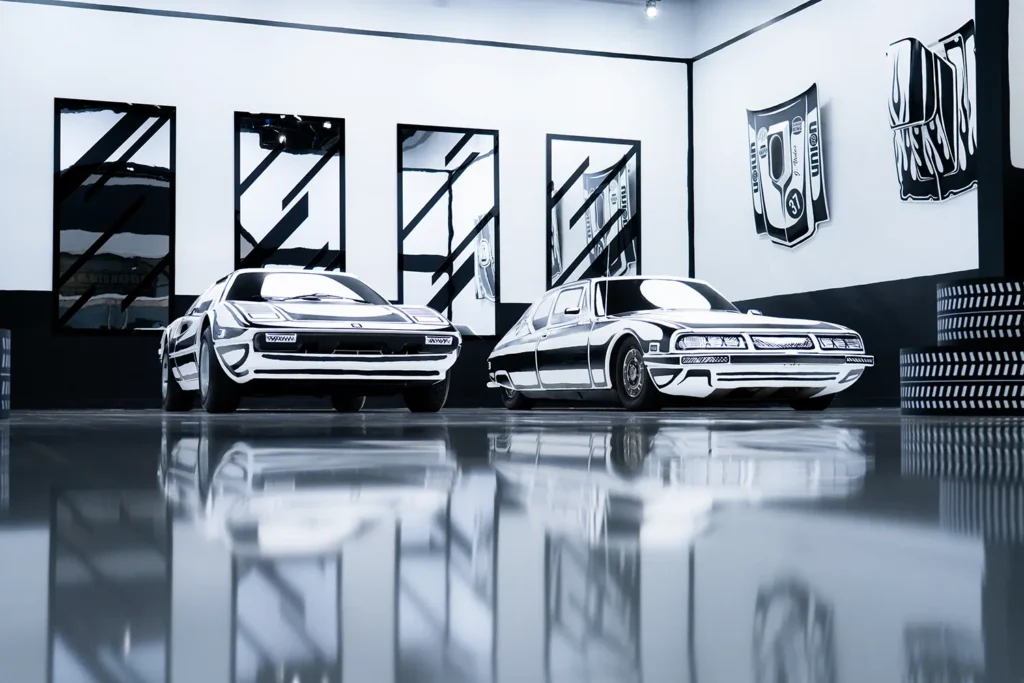
The Petersen Automotive Museum has presented the finished gallery as a kind of real-life sketchbook, but the description only begins to explain what makes the installation unusual. The sketch does not sit inside the architecture. The architecture has been absorbed into it.
That is where Flat Out becomes more than an exercise in turning cars into illustrations. The familiar Vides treatment is no longer confined to an individual object. It expands outward until the entire environment follows the same logic.

The cars may initially draw the eye, but the room gradually becomes the more compelling subject. Once everything is reduced to black lines and white surfaces, the usual hierarchy of an automotive exhibition begins to disappear. There is no obvious background, no neutral wall separating object from artwork, and no clear point at which the drawing ends.
Five cars occupy the space, but the real transformation belongs to everything around them.
Flat Out: The Art of Joshua Vides is on view at the Petersen Automotive Museum in Los Angeles.