
As the renewable energy sector continues to expand, a less visible challenge is beginning to demand greater attention: what happens when wind turbines reach the end of their operational life. While wind power remains central to the global energy transition, the disposal of decommissioned turbine blades has emerged as a significant environmental and industrial issue.
Built from composite materials engineered for maximum durability, these massive structures are exceptionally difficult to recycle through conventional means. Yet rather than treating them purely as waste, designers, engineers, and researchers are beginning to reimagine them as valuable resources for entirely new applications.
One of the key difficulties lies in the very materials that made wind turbines such an engineering success. Composite blends of fiberglass, epoxy resins, and other high-performance materials offer strength, weather resistance, and longevity, but those same qualities make separation and recycling highly complex. As thousands of blades approach retirement globally, finding scalable alternatives to landfill disposal has become increasingly urgent.
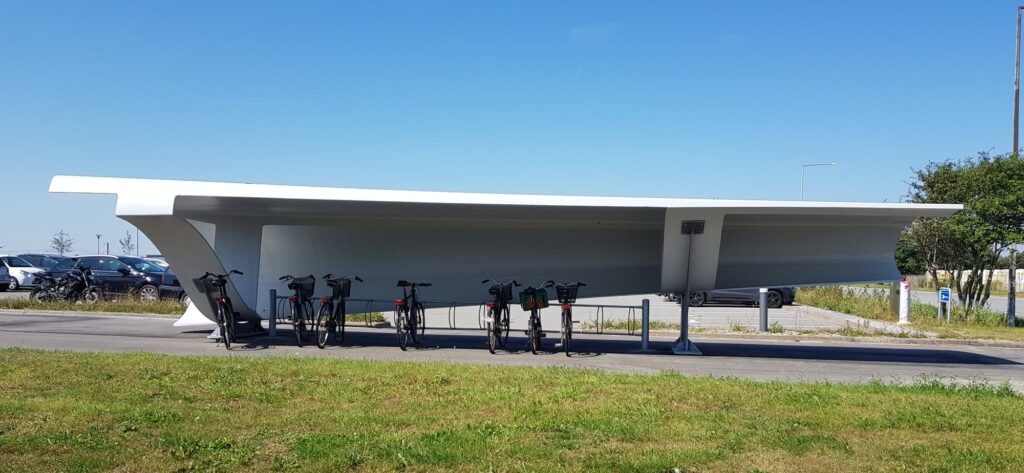
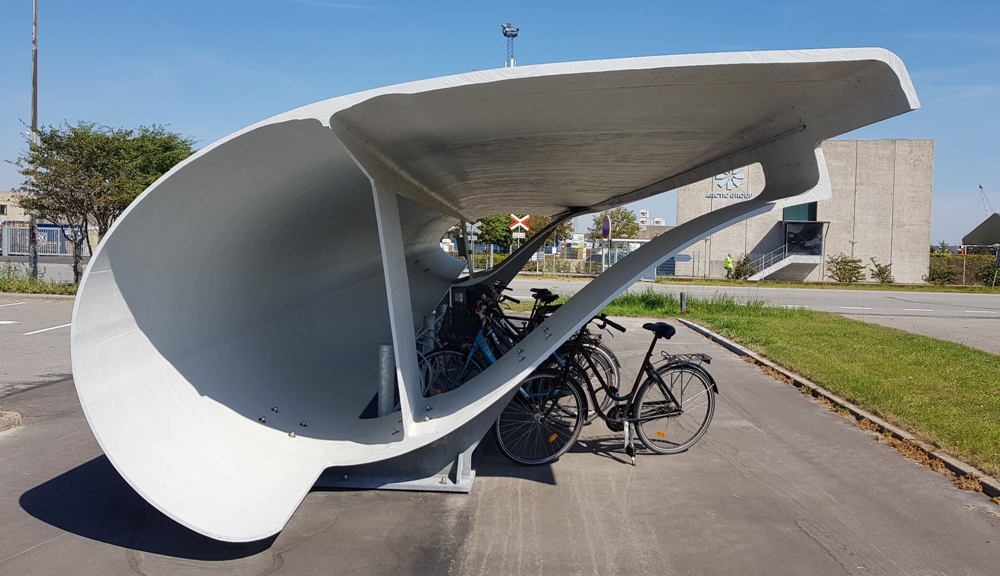
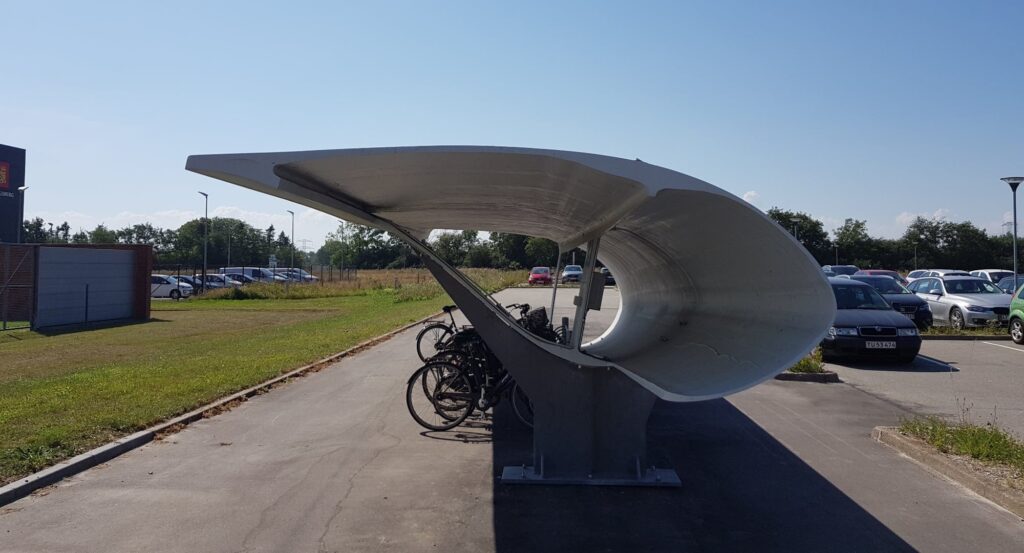
In Denmark, where wind energy has long been embedded into national infrastructure, innovative reuse strategies are already taking shape. In the city of Aalborg, retired turbine blades have been repurposed into bicycle shelters, turning industrial remnants into practical pieces of urban infrastructure. Their aerodynamic forms, structural resilience, and weather-resistant composition make them unexpectedly well suited to protecting bicycles from the Scandinavian climate. In a country where cycling plays a major role in daily mobility, the adaptation feels both functional and culturally fitting.
Elsewhere in Europe, decommissioned blades are being considered for more ambitious infrastructural uses. In Ireland, where substantial volumes of retired blades are expected in the coming years, designers have proposed integrating them into bridge construction for greenway developments, using their structural integrity and natural curvature as architectural assets rather than liabilities. In the UK, reclaimed turbine blade materials have already been tested as reinforcement components in major infrastructure projects, offering a potential alternative to more carbon-intensive materials such as steel.
Research institutions are also exploring how these structures might be re-engineered at a material level. In the United States, experimental architectural projects have incorporated large blade sections into small-scale buildings, demonstrating their potential as load-bearing or protective structures. Other studies have examined their suitability for applications such as utility poles and other civil engineering uses.
At the same time, more advanced recycling technologies are beginning to emerge. Danish manufacturer Vestas, working alongside academic researchers, has developed processes capable of chemically separating blade components to recover epoxy materials for reuse in new turbine production. Similar innovation is underway in Northern Europe, where engineers are exploring methods to extract and repurpose fiberglass at scale, potentially transforming what was once a waste problem into a valuable industrial supply stream.
These developments point toward a broader shift in how renewable infrastructure is understood. Sustainability cannot end at energy generation; it must also address the full lifecycle of the technologies that make that generation possible. The challenge of retired wind turbine blades highlights an important reality of the green transition: truly sustainable systems require not only clean energy, but equally thoughtful approaches to material afterlife, circular design, and industrial reinvention.
Photos by Siemens Gamesa
